victim registry records
13,053 records synced with the current source registry
Iran · 1979—present
IranArchive preserves names, evidence, and source trails for the crimes the Islamic Republic has tried to hide—from prison massacres and protest killings to gender persecution and digital blackouts.
The record
These figures describe the current scope of this archive and the blackout documented below. They are not a substitute for the individual records, testimony, and evidence.
13,053 records synced with the current source registry
Bounded claims backed by rights investigations
Plus 19 hours and 30 minutes in 2026
From the establishment of the Islamic Republic to today
Pattern recognition
Across decades and movements, the same architecture reappears: securitize dissent, use force, disappear the detained, silence witnesses, and deny accountability.
Live ammunition, metal pellets, and lethal force have repeatedly been used against protesters and bystanders, including children.
Explore documented incidentsMass arrests are followed by incommunicado detention, coerced confessions, torture, sexual violence, and pressure on families.
Human Rights Watch · 2026The UN fact-finding mission found that violations against women, girls, and supporters of equality amounted to crimes against humanity.
UN Fact-Finding MissionInternet shutdowns, filtering, surveillance, and whitelisted access isolate the public while abuses are carried out beyond scrutiny.
Go to the blackout reportHistorical record
A selected chronology of state violence and repression. Each entry links to the investigation supporting the claim.
Thousands of imprisoned political dissidents were forcibly disappeared and extrajudicially executed, then buried largely in unmarked mass graves.
Amnesty InternationalSecurity forces and state-sanctioned vigilantes attacked student residences; at least one student was killed and hundreds were arrested.
Amnesty InternationalSecurity forces used lethal and excessive force against election protesters, followed by mass detention, torture, and coerced confessions.
Human Rights WatchA nationwide internet shutdown accompanied a lethal crackdown. Rights groups documented unlawful force, mass arrests, and a deliberate cover-up.
Human Rights WatchThe UN mission found murder, imprisonment, torture, rape, persecution, enforced disappearance, and other inhumane acts in a widespread and systematic attack.
UN Fact-Finding MissionVerified videos and testimony show security forces firing on protesters while a nationwide blackout obstructed documentation and concealed the scale of killing.
Amnesty InternationalInformation is evidence
The blackout is not a technical footnote. It isolates people, destroys livelihoods, obstructs documentation, and gives state violence cover. IranArchive keeps the full 2026 report on the landing page.
Dossier 2026.01 · Digital repression
January 8 → May 26, 2026
Total time unrestricted global internet was not generally available to the Iranian public
Traffic partially recovered, but meaningful global access remained unavailable to the general public and was largely reserved for government-linked or whitelisted users, including “white SIM” holders.
Traffic collapsed to near zero during the nationwide protest crackdown.
Small amounts of traffic returned twice, but neither window became sustained, generally available public access.
Traffic partially recovered, but the public digital blackout continued through aggressive filtering and privileged access for selected users and white SIM cards.
Connectivity again fell to near zero as the war began.
International connectivity began a sustained rise after 2,093 hours of the wartime phase, ending the counted blackout period.
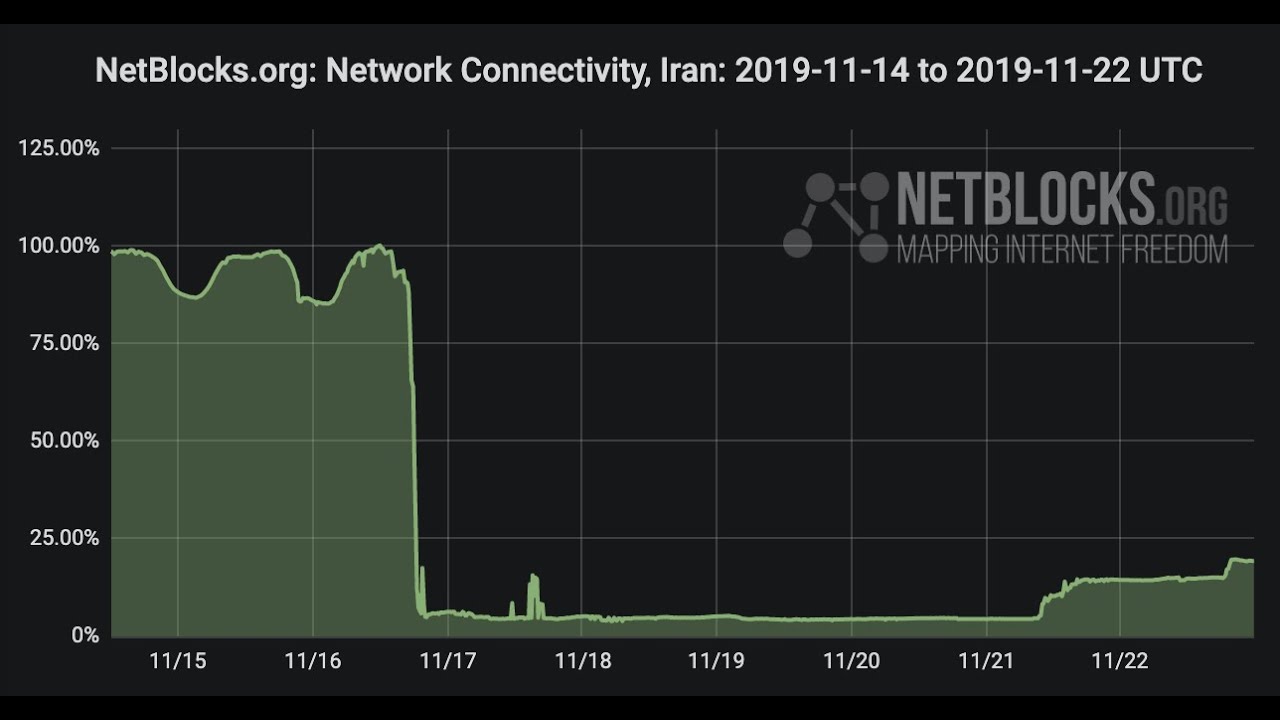
NetBlocks measured national connectivity collapsing to roughly 5% as authorities suppressed the November 2019 protests. The tactic returned at greater duration in 2026.
Graphic: NetBlocks · unaltered, used with source attributionExplore IranArchive
Search the people, incidents, source material, and worldwide actions connected to the record.
Names, portraits, biographies, and case records.
Enter the memorialSource-linked records of killings, crackdowns, and repression.
Review incidentsArchival media and documents preserved for public scrutiny.
Browse evidenceA historical and current record of solidarity actions worldwide.
View the timelineWhy this archive exists
Documentation is an act of resistance against disappearance, denial, and impunity. Preserve the record. Cite the evidence. Remember the people.
Source note: estimates from closed information environments can change as evidence emerges. IranArchive distinguishes archive counts from reported casualty estimates and links every external claim on this page to its source.